
Squirrel Removal Service – Michigan
Squirrel Removal Service for Properties Across MI
Not every squirrel problem looks the same, and knowing what you are dealing with can make a difference when wildlife becomes a concern. Squirrels can differ in their habits, movements, nesting patterns, and feeding behaviors, giving property owners useful clues about activity around their property.
This is also why providing a squirrel removal service involves more than simply treating the situation like general pest control in MI. Understanding squirrel behavior can help explain why they enter certain areas, where they may be nesting, and what could be attracting them to a property. These details can also help identify signs of activity and possible areas of concern.
When you contact us at B&B Wildlife Removal, Inc. about squirrel activity, details about these behaviors can help us better understand what may be happening. Recognizing the differences between squirrel species can also provide useful insight into their activity and the appropriate way to address the situation.
The most common squirrels in Michigan are the gray squirrel, red squirrel, eastern fox squirrel, and the flying squirrel. All of these squirrels are aerialists who spend much of their time in trees, attics, and other high places; but there are important differences between them as noted on this page.
The squirrel can become a nuisance when it chews through the facia board or roof and gains access into your soffit and attic. If you think you have a squirrel in your attic, think again. You have more than one, usually 4 or 5 or more. Squirrels are very social animals and will stay as a family unit.
If you try and resolve the squirrel problem yourself, you may end up enclosing a squirrel or squirrels in your attic which will cause major damage as the enclosed squirrel or squirrels will chew a hole to get out. If one or more of the squirrel family members are outside, they will assist the enclosed squirrel or squirrels in chewing the hole.
Red Squirrel (Tamiasciurus hudsonicus)
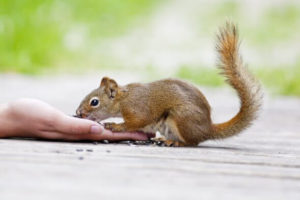 The red squirrel lives throughout the state. Red squirrels are found in a variety of forested habitats, including coniferous, deciduous, and mixed forests. They are also commonly found in suburban settings where there are large stands of mature trees. Red squirrels are also fairly aggressive small animals and will defend themselves if cornered.
Red squirrels can severely damage young trees and crops in storage. They may also gnaw on many household items and can become a nuisance if they nest in homes. Red squirrels have keen senses of smell, sight, and hearing. They are very vocal and loudly scold intruders in their home range. Vocalizations consist of rattles, screeches, growls, buzzes, and chirps.
Red Squirrel Sound:
Breeding season: January to February – Number of offspring: 1 to 8 – Gestation period: 33 to 35 days
Average lifespan: 7 years
Eastern Gray Squirrels (Sciurus carolinensis)
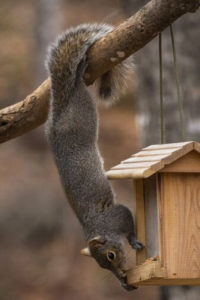 Gray squirrels are bushy tailed rodents with a mixture of brown, black, and white fur which when viewed from a distance blend together to look gray. They are found throughout Michigan in mixed hardwood forests as well as in suburban and urban areas. They prefer forests with mature, nut producing trees such as oak and walnut.
Gray squirrels will use old woodpecker holes or natural cavities as dens to live in and raise young. They will also build large nests composed of leaves and twigs. Gray squirrels have adjusted well to manmade changes to the landscape and are a familiar animal in neighborhoods and city parks. They are considered very destructive to property.
Eastern gray squirrels communicate among themselves with a variety of vocalizations and postures, such as tail flicking. The conspicuous bushy tail of the gray squirrel has many uses. It is used for balance, a blanket, an umbrella, parachute, and communication. Eastern gray squirrels are also hosts for parasites such as ticks, fleas, lice, and roundworms.
Eastern Gray Squirrel Sound:
Breeding season: Breeding occurs in December-February and May-June and is slightly delayed in more northern latitudes. – Number of offspring: 2 to 8; avg. 3 – Gestation period: 44 days (average)
Average lifespan: 12.50 years
Eastern Fox Squirrel (Sciurus niger)
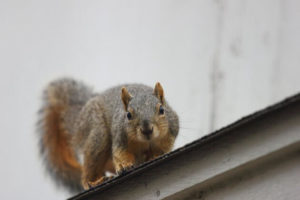 Fox squirrels are a medium-sized tree squirrel. They are often considered a nuisance species due to their raiding of bird feeders and gardens. They are also responsible for some damage to corn crops. They often use electrical lines as routes of travel, and this can cause power outages. Fox squirrels will threaten one another by standing upright with their tail over their back and flicking it.
At one and a half to two and a half pounds, the fox squirrel is heavier than the gray and is also longer at 10 to 15 inches (minus the tail). Fox squirrels prefer small woodlots of mature trees throughout the Lower Peninsula. Those that reside in southern Lower Michigan customarily do so in city parks and suburbs with mature trees. As with other squirrels, they can produce great damage to property, crops and dwellings.
Eastern Fox Squirrel Sound:
Breeding season: December to February and May to June. – Number of offspring: 1 to 6; avg. 3 – Gestation period: 44 days (average) – Average lifespan: less than one year. Most Fox Squirrels die before they reach adulthood.
Northern Flying Squirrel (Glaucomys sabrinus)
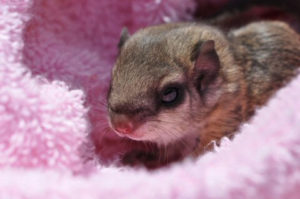 Few people have seen a flying squirrel because they are active only at night. They are more common than many people think, especially in southern Michigan, and can be attracted to bird feeders. Northern Flying Squirrels are clumsy on the ground, but can glide gracefully from tree to tree. They sometimes share nests and may live in groups of up to 8 adults and juveniles.
Northern flying squirrels sometimes select den sites in houses and barns, which is undesireable due to the noisy activity at night and the litter from nests and seed caches. Northern flying squirrels emit a soft low chirp, and they cluck when distressed. They also use scent and touch to communicate with one another.
Northern Flying Squirrel Sound:
Breeding season: Mating occurs between March and May. – Number of offspring: 1 to 6; avg. 3 – Gestation period: 37 to 42 days – Average lifespan: 4 years or less
Serving Southeast Michigan
Oakland County Squirrel Removal Service
Auburn Hills | Berkley | Birmingham | Bloomfield | Bloomfield Hills Twp.| Clarkston | Commerce | Highland | Milford | Novi | Farmington | Farmington Hills | Highland | Keego Harbor | Lake Orion | Ortonville | Rochester | Rochester Hills | Royal Oak | Southfield | Troy | Union Lake | Walled Lake | Waterford | West Bloomfield | White Lake | Wixom
Wayne County Squirrel Removal Service
Canton | Detroit | Livonia | Northville | Plymouth | Wayne
Livingston County Squirrel Removal Service
Brighton | Fowlerville | Hartland | Howell | Pinckney | Whitmore Lake
Macomb County Squirrel Removal Service
Centerline | Clinton Township | Fraser | Macomb Township | Roseville | Shelby Township | Sterling Heights | Utica | Warren
Frequently Asked Questions
Can squirrels enter a home through a small opening?
Yes. Squirrels can take advantage of relatively small openings around a property to reach sheltered areas. If you notice signs of wildlife activity near an opening, it is worth having the area assessed before assuming the problem will resolve on its own.
Can I remove squirrels from my attic myself?
No. Trying to remove squirrels without knowing how they are getting in or out can create additional problems. It is safer to have the situation properly assessed so the animals and the property can be handled appropriately.
Can squirrels return after they have been removed?
Yes. If the access point that allowed squirrels onto the property remains available, the same or other wildlife may find its way back.
Does seeing one squirrel mean there are more nearby?
Not necessarily. Squirrels can be active alone, but some may also remain close to family members or nesting areas.
Can I contact B&B Wildlife Removal if I am only concerned about squirrel activity?
Yes. You do not have to wait until the situation becomes a major concern before reaching out. If you have noticed unusual activity and are unsure what it means, we can help you better understand the situation and discuss the appropriate next step.